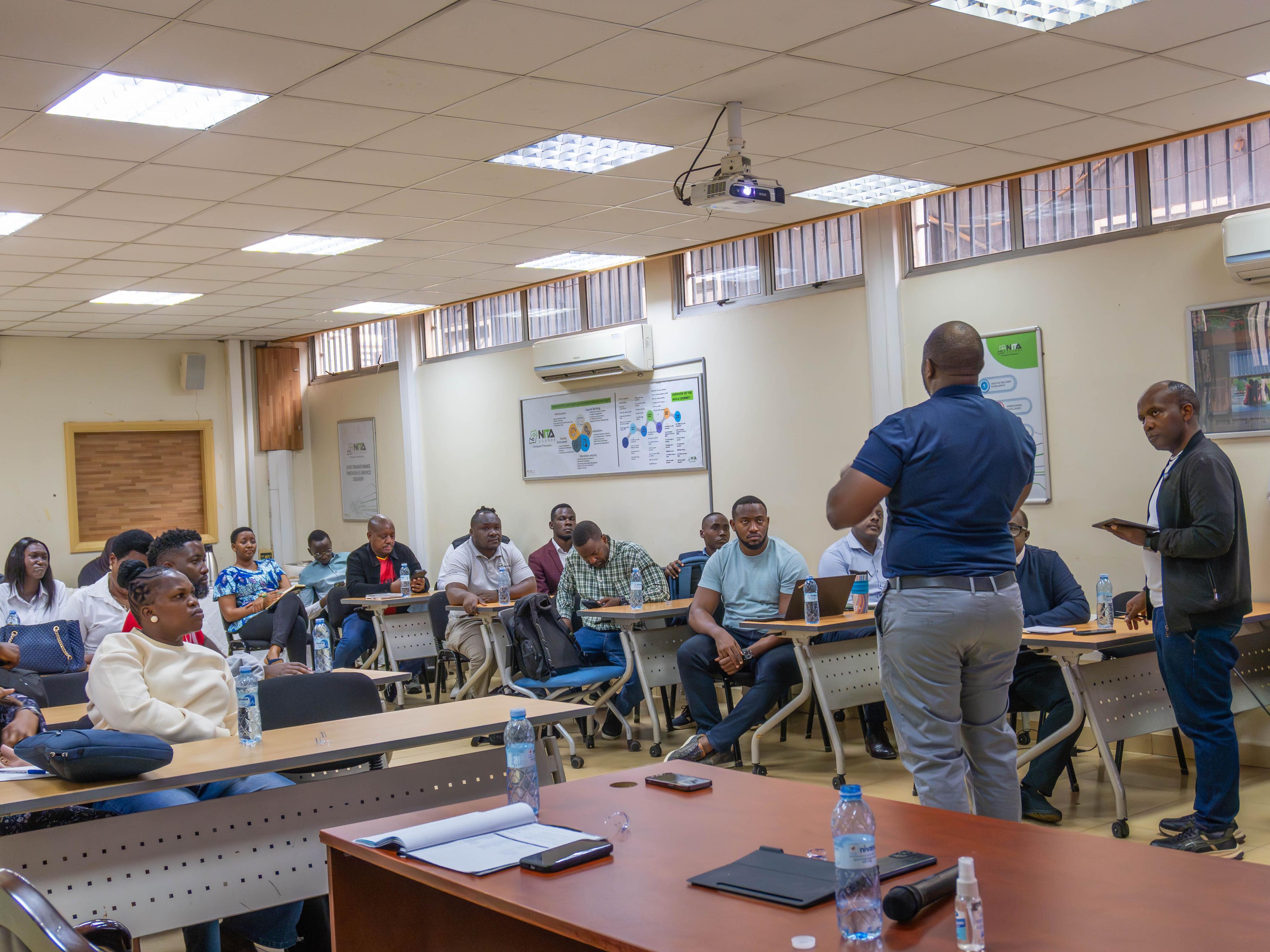
Last week, we gathered senior technology executives at the Ministry of ICT and National Guidance for a Working Groups Orientation and Charter Setting Session, a structured effort to move Uganda's ICT leadership community from passive observers of policy to active architects of it. The Co-chairs of the session, George Ouma and Newton Brian Ajuna, guided the Tech Execs through the vision, expectations, and strategic direction before establishing seven working groups spanning digital skills, cybersecurity, artificial intelligence, digital adoption, regulation, sustainable finance, and digital transformation.
From the outset, the session's leadership made clear that the Forum's intent was not to add another conference to Uganda's crowded calendar of technology events. In his opening statements, Newton Brian Ajuna emphasized that the purpose of the engagement was not only to establish committees but to create impactful platforms that would shape national conversations around ICT, digital transformation, cybersecurity, artificial intelligence, policy, and digital skills development.
He noted that the Forum’s objective is to move beyond ordinary discussions and position ICT leaders as strategic contributors to national development. Further highlighting the importance of involving practitioners directly in technical conversations and ensuring that discussions remain practical, inclusive, and solution-oriented.
Reinforcing Ajuna's remarks, George Ouma described the working groups not as discussion panels but as strategic think tanks responsible for producing actionable insights, policy recommendations, technical guidance, and industry position papers.
Ouma emphasized that the Forum has access to key government stakeholders, policymakers, and institutions, creating an opportunity for ICT practitioners to directly shape conversations around Uganda’s digital future.
A recurring theme throughout the engagement was the need for ICT professionals to intentionally position themselves as active contributors to Uganda’s development agenda rather than remaining passive observers of policy and regulatory decisions. The Forum emphasized the importance of taking a more proactive role in shaping the country’s digital future.
Seven working groups, one overarching objective
The session formally constituted seven thematic working groups, each assigned a dedicated focus area, proposed leads, and a set of 2026 priorities aligned with the Forum's concept note. Each group is expected to meet monthly for 90-minute sessions, virtually or in-person, and produce at least one substantive output per quarter: a position note, a practitioner brief, a set of policy recommendations, or a policy response document. Those outputs are intended to form the backbone of the Forum's corresponding quarterly roundtable sessions.
The Tech Execs were informed that the working group will explore practical ways to strengthen the sector’s contribution to employment creation, innovation, and economic growth.
WG1 - Digital Skills and Talent: will focus on industry-aligned certification pathways, the operationalization of a National Talent Registry, curriculum alignment with universities, modular learning pathways for the informal sector, and the embedding of cybersecurity literacy within skilling programmes.
WG2 - Cybersecurity and Governance: will address cross-border cyber threat intelligence sharing, data protection compliance, cloud and fintech cybersecurity readiness, and governance frameworks for digital infrastructure.
WG3 - AI, Data and Innovation: will take on questions of AI governance, data policy, cloud regulation, interoperable data platforms, and the practical application of artificial intelligence as a tool for African enterprise rather than a theoretical ambition.
WG4 - Digital Adoption and Customer Experience: will examine the persistent gap between internet coverage and productive use, device financing barriers, digital service delivery for the informal sector, and the role of energy resilience in connectivity expansion.
WG5 - Policy, Regulation and Compliance: will engage with licensing predictability, right-of-way approvals, spectrum pricing rationalization, data localization guidance, and public-private consultation frameworks.
WG6 - Sustainable Finance and Cost Efficiency: will focus on blended finance models for digital infrastructure, pooled procurement strategies, spectrum taxation predictability, and operational efficiency at the enterprise level.
WG7 - Digital Transformation and Jobs: will treat digital transformation as a measurable employment and economic strategy, tracking income growth among digitally integrated businesses, supporting SME onboarding into digital systems, and advancing cross-border payment interoperability.
Digital skills as economic infrastructure
Among the seven thematic areas, the session gave particular prominence to the relationship between digital skills and national economic development, a framing that carries significance given Uganda's ongoing National Development Planning process.
The Forum's leadership argued that digital skills must be understood not as a sector-specific concern but as economic infrastructure: as foundational to national productivity as roads, electricity, or financial systems. Discussions centred on the standardization of certifications, the harmonization of ICT competencies across institutions, and the alignment of university curricula with industry needs.
The working group will provide evidence-based analysis to inform Uganda's National Development Plan V (NDP V), signaling the Forum's commitment to engage in formal planning rather than just commentary.
The internet infrastructure conversation cannot wait
One of the more technically substantive discussions during the open segment of the session concerned internet infrastructure, an area that senior technology professionals say receives insufficient attention in national policy circles.
A Tech Exec from the technical community raised concerns about DNS security, IPv4 exhaustion, the sluggish transition to IPv6, internet peering exchange capacity, and the broader question of national internet resilience.
These issues, the Tech Execs argued, are not esoteric technical matters; they are preconditions for the digital services, IoT expansion, and e-government platforms that policymakers routinely champion.
The Forum leadership welcomed calls for dedicated technical sessions and committed to organizing focused engagements on internet governance, with relevant stakeholders including representatives from the National Information Technology Authority-Uganda (NITA-U) and international internet governance bodies.
Engaging policymakers early: A lesson from past failures
The Tech Execs encouraged the CIO-CXO Digital Leadership Forum to embed government commissioners and ministry officials within the working groups from the outset, not as observers, but as active participants. The leadership acknowledged the recommendation and noted that existing linkages with the Ministry of ICT & National Guidance create a foundation for this kind of co-creation.
The ambition, as one Tech Exec summarized it, is unambiguous: "The goal is impact, not just another talk."
A sector taking responsibility
Underlying the entire session was a recognition, at times stated plainly, at times implied, that Uganda's ICT sector has for too long left the shaping of its own regulatory and policy environment to others.
The session's recurring message was one of professional accountability. ICT leaders, the Forum argued, can no longer afford to engage with policy only after it has been written. The establishment of these working groups is, in that sense, as much a cultural statement as an organizational one.
With seven working groups now constituted, quarterly deliverables committed, and government access in place, the CIO–CXO Digital Leadership Forum has set itself a significant test. Whether it can convert the ambition of this session into outputs that genuinely influence national policy will be the measure by which it is ultimately judged.