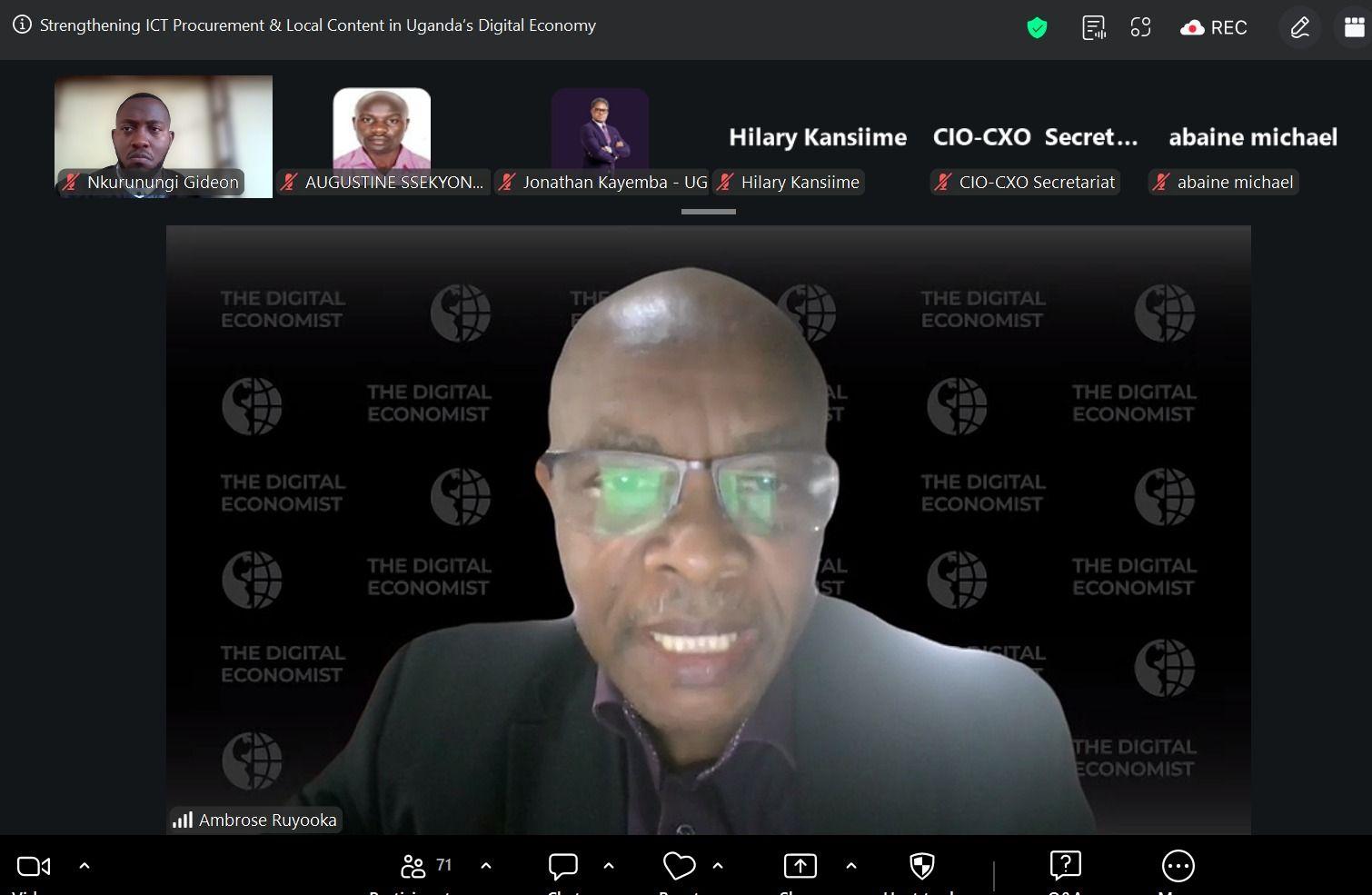
This morning, we convened our inaugural ICT Industry Engagement Webinar Series, with the first discussion focused on “ICT Procurement and Local Content.” Held virtually, the session brought together key stakeholders to explore how inclusive ICT procurement practices can strengthen local participation and accelerate Uganda’s digital economy.
The webinar was convened in partnership with the Public Procurement & Disposal of Public Assets Authority (PPDA Uganda) , National Information Technology Authority-Uganda (NITA-Uganda), and the Ministry of ICT & National Guidance.
Uganda's Fourth National Development Plan (NDP IV) makes digital transformation a pillar of national economic growth. Government spending on ICT goods and services is rising. The demand for technology in public service delivery is not going down. The question NDP IV asks is a blunt one: who builds it, who maintains it, and who captures the value?
The answer, right now, is mostly not Uganda's local ICT industry. And today, we engaged directly with the regulator, PPDA Uganda, to have an honest conversation about why.
The structural issue that no one in this sector needs to be explained to them is the reservation threshold. Under Uganda's current procurement framework, ICT consultancy contracts are worth UGX 300 million. Road works contracts up to UGX 15 billion are reserved for nationals. The fifty-fold gap between those two numbers is not a technicality. It means that the moment a government ICT contract of any meaningful scale goes to market, local ICT companies are competing against international firms with no structural protection whatsoever.
That is what the CIO-CXO Digital Leadership Forum was built to change.
Today was not the moment to change it. Today was the moment to build the foundation. And the foundation we built was real.
Representing PPDA Uganda, Baluka Mariam and Abaine Michael engaged 103 participants from different ICT companies in a candid and insightful discussion, highlighting three key messages the Forum needed to hear clearly:
- Reservation thresholds are not static. They can be reviewed and adjusted through sustained, evidence-based engagement. The construction sector successfully demonstrated this through UNABSEC, and the ICT sector has the same opportunity to do so.
- The data required to support a case for threshold revision exists, and PPDA Uganda is willing to work with institutions that can help generate it. The Forum has now formally offered to conduct that research.
- Capacity building engagement of this kind needs to happen more, not less. PPDA Uganda's willingness to return quarterly is on the table.
The Forum's Governing Board Chair, Jonathan Kayemba, set the intellectual frame for the session. He argued that public procurement is not a spending function. It is an industrial policy tool. Every shilling the government spends on ICT is a decision about whether Uganda is buying technology or building an industry. Local content, properly understood, is not a compliance burden. It is the mechanism through which Uganda builds the firms, the skills, the data sovereignty, and the economic independence that NDP IV requires.
NITA-U's Augustine Ssekyondwa reinforced it from the implementation side. Three questions should govern every government ICT procurement: does it improve service delivery, does it strengthen national digital sovereignty, and does it create opportunities for Ugandan firms? Where those three cannot be answered, the procurement needs restructuring before it goes out.
The questions from participants were not polite. They were exactly the kind that this Forum should be generating. Juliet Opio, Management Information Systems Manager at Africa Global Logistics Uganda asked the question that the whole room was thinking: how does local content regulation apply to private-sector procurement, not just government contracts, given that the biggest ICT business in Uganda flows through the private sector? That question does not yet have a full answer. The Forum intends to find one.
The Commissioner Ambrose Ruyooka from the Ministry of ICT and National Guidance added a dimension that went beyond today's threshold conversation. Uganda is about to start procuring AI systems. The procurement frameworks that work for hardware and connectivity do not work for systems that learn, evolve, and generate outputs that may change after deployment.
The ICT Ministry is developing Uganda's AI governance framework, and the Forum will be submitting formal comments on the draft, which goes out for national validation on May 29th.
The session concluded with a noteworthy commitment from the Forum’s Secretariat. The Forum will undertake structured research on the participation of local ICT firms in government procurement, develop the evidence base required by PPDA for threshold review, and submit a formal proposal by the end of the year. Additionally, the Forum proposed a Memorandum of Understanding with PPDA to establish a structured quarterly capacity-building programme commencing in Q3 2026.
The outcomes of today’s session will be documented, presented to the Board, and translated into clear actions with defined timelines. This is the only way to ensure that such engagements lead to tangible results, rather than remaining as goodwill alone.
Next up: On May 29th, 2026, we will convene the Working Group Charter Setting session at the Ministry of ICT & National Guidance’s ISC Seminar Room. This session will lay the foundation for the monthly Working Group engagements moving forward, followed by CIO Roundtables at the close of each month. Quarterly regulator engagements will then resume in August as part of the broader industry coordination agenda.