Uganda’s artificial intelligence conversation is entering a new phase, with technology leaders increasingly calling for organizations to move beyond AI experimentation and focus on measurable business results.
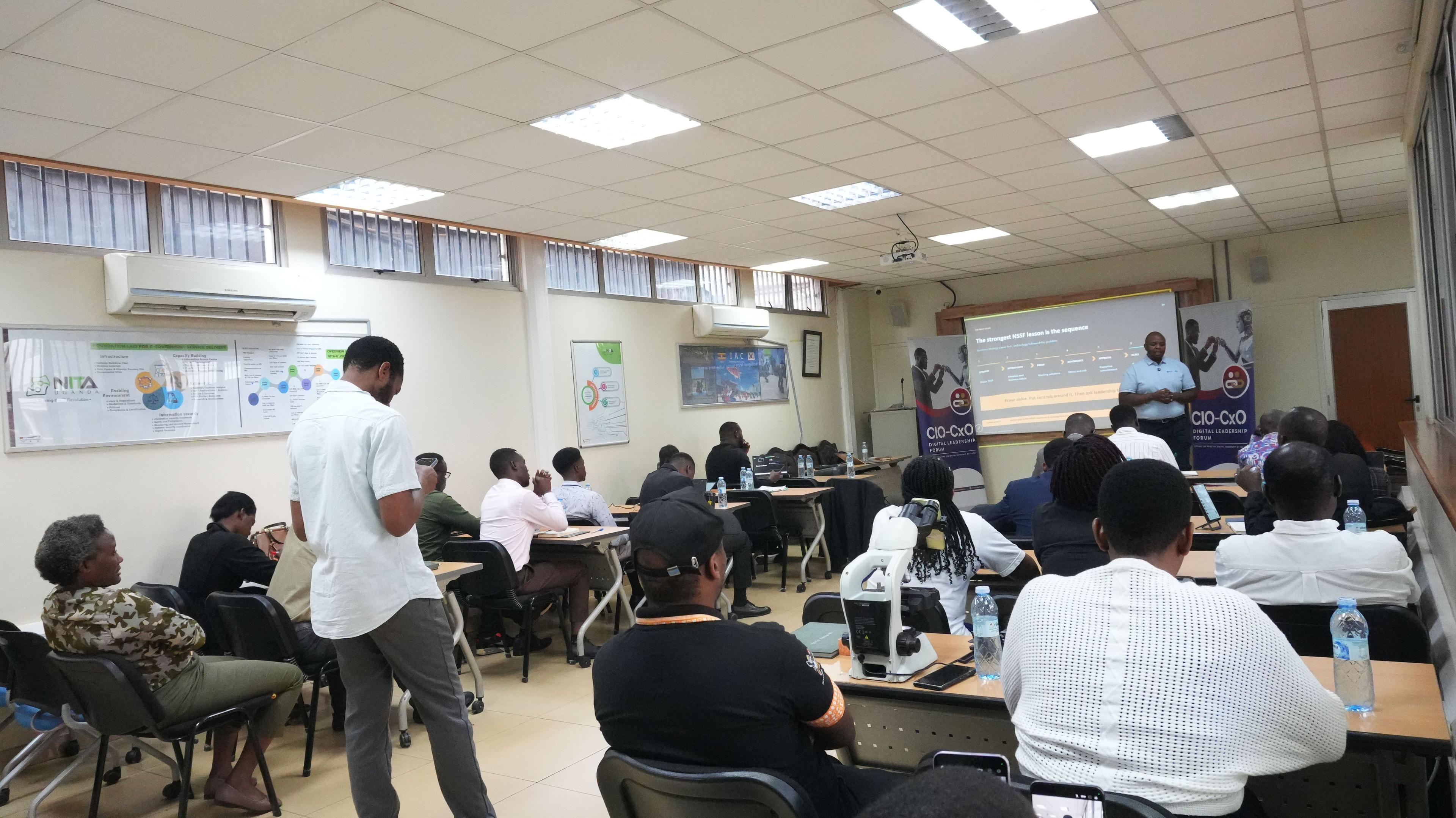
The shift was a central theme at a CIO–CXO Digital Leadership Forum roundtable held on 31 July 2026 under the theme “AI Data: From hype to enterprise value.” The session brought together C-suite executives, technology leaders, researchers, innovators and practitioners to examine how organizations can turn AI pilots into sustainable enterprise capabilities.
The discussion was anchored on a fundamental question: how can organizations move from isolated experiments and demonstrations to AI solutions that deliver measurable value?
From AI pilots to business results
“AI is no longer the question; the question is how we move from isolated pilots to measure enterprise value,” said George Ouma, Senior IT Project Manager at NSSF. “Addressing this shift requires moving beyond technical novelty to focus on business outcomes, enterprise capability, trusted data, pragmatic governance, and human-centered design.”
Participants argued that organizations need to rethink how they approach AI projects, beginning with the business problem rather than the technology itself.
Instead of starting with a decision to build an AI model, leaders were encouraged to first define the outcome they want to achieve and determine how that outcome will be measured.
For example, an organization considering an AI-powered fraud detection system should focus not only on developing the model but on the specific business objective such as reducing avoidable fraud losses while protecting customers.
This approach, participants said, gives AI initiatives clear ownership, measurable baselines and a stronger basis for determining whether an investment is delivering value.
The session also cautioned organizations against accumulating AI pilots without a clear path to implementation. Successful pilots, it argued, should help leadership decide whether to scale, improve or stop a particular solution.
Fragmentation and duplication were identified as emerging challenges, with organizations at risk of developing multiple tools that perform similar functions across different departments.
The alternative is to build reusable AI capabilities, common standards and solutions that can be applied across multiple business functions.
Data readiness emerges as a critical factor
Data was another major focus of the discussion, with participants emphasizing that having large volumes of data does not automatically make an organization AI-ready.
What organizations need, they argued, is “ready data” data that is trusted, sufficiently complete and relevant to the decisions being made.
For example, before an institution like the National Social Security Fund (NSSF) can deploy AI to automate employer compliance follow-ups, it must first establish absolute clarity on employer contribution statuses, target profiles, and payment histories. AI cannot compensate for foundational data deficiencies; dashboards and analytical outputs are only as valuable as the business decisions they enable.
Participants consequently highlighted data quality, completeness, currency, provenance and relevance as important components of successful AI adoption.
Governance must enable responsible adoption
Parallel to data readiness is the need for modern, enabling governance. As organizations move AI applications into production, governance is also becoming a critical consideration.
The discussion acknowledged that policy and approval processes can sometimes move more slowly than AI technology, creating uncertainty for organizations seeking to scale successful pilots.
However, participants argued that governance should not simply be viewed as a mechanism for restricting AI adoption. Instead, it should provide the confidence organizations need to deploy AI responsibly. This includes establishing clear ownership, risk appetite, validation processes, monitoring systems, incident management and escalation mechanisms.
The session also discussed Uganda’s emerging AI policy environment and the importance of organizations developing practical internal governance frameworks.
“We don’t have to wait for policy to start building; we can establish responsible governance and create value now,” one of the key messages from the discussion stated.
AI is changing work, but people remain central
The impact of AI on employment and the future of work also featured prominently in the discussion. Rather than viewing AI solely as a technology that will replace workers, participants highlighted its potential to help employees make better decisions, identify exceptions, improve productivity and create new capabilities.
“AI is changing work, but human judgement, expertise and accountability remain essential,” participants agreed to this, while stressing that AI-generated outputs still require human validation, particularly where decisions have significant consequences.
Over-reliance on automated systems without oversight exposes organizations to risks ranging from unverified outputs and hallucinations to skill degradation. Critical decisions particularly in high-consequence environments like healthcare, finance, and legal compliance require human validation and ethical oversight.
Preparing the workforce for this shift requires proactive skill development. Organizations must invest in building enterprise-wide AI literacy alongside specialized roles in prompt design, algorithmic quality assurance, data engineering, and cybersecurity. Broadening capability ensures that staff can direct, audit, and safely collaborate with intelligent systems.
Local solutions show Uganda’s potential
The session also showcased examples of AI being developed around local challenges.
Dr. Rose Nakasi presented work in AI for healthcare, including an ocular diagnostic tool combining microscopes, smartphones, and adapters to support diagnostic workflows in environments where specialized diagnostic capacity may be limited. Emphasized that technical accuracy must be coupled with domain validation, contextual adaptation, and localized communication.
The example highlighted the importance of designing AI around local realities. Participants noted that technical accuracy alone is not sufficient in healthcare, where AI systems require expert validation, quality controls and attention to issues such as bias and annotation quality.
The work also demonstrated how AI-generated information can potentially be translated into local languages, improving accessibility for patients and other users.
Nesta Paul Katende on the other hand, presented an enterprise-focused approach to agentic AI, with emphasis on systems that integrate directly into organizational operations.
“Enterprise agentic systems are built to integrate directly into operations without exporting the organization’s data,” Katende said.
The approach places data sovereignty at the centre of enterprise AI, particularly for organizations handling sensitive customer, financial and operational information.
Katende also highlighted the importance of domain knowledge in developing useful AI solutions, arguing that innovators do not necessarily need to begin as specialist engineers if they have a deep understanding of a particular industry and how AI can address its challenges.
The opportunity for Uganda
The discussions pointed to a broader opportunity for Uganda to move beyond simply consuming global AI products and instead combine local talent, data, domain expertise and enterprise challenges to develop solutions suited to the country's needs.
The health and enterprise examples presented during the session demonstrated different applications of the technology, but both pointed to the same underlying principle: successful AI adoption begins with a real problem, requires trusted data and appropriate expertise, and must ultimately deliver a measurable outcome.
The Forum identified several priorities for organisations seeking to advance their AI strategies, including establishing measurable business outcomes, reducing duplication, improving data readiness, developing practical governance frameworks, investing in workforce skills and strengthening collaboration between government, academia, innovators and the private sector.
The message emerging from the roundtable was therefore less about adopting AI for its own sake and more about building the capabilities required to make it useful.
“Start with the outcome, make it measurable, and continuously show progress and value,” the session recommended.
For Uganda’s technology ecosystem, the challenge ahead is no longer whether AI has potential. It is whether organisations can turn that potential into practical, responsible and scalable value.
As the roundtable concluded, the opportunity is not simply to adopt more AI tools, but to build AI capabilities that are measurable, trusted, locally relevant and scalable.